

Collagen Supplement ODM vs OEM: Key Differences, Manufacturing Costs, and How to Choose the Right Partner
日期:2026-10-23
What Is Collagen Supplement ODM?
Collagen supplement ODM, or Original Design Manufacturing, is a business model in which a specialized supplement manufacturer provides product development services alongside manufacturing capabilities. Depending on the agreement, an ODM partner may assist with ingredient selection, formulation design, flavor development, product testing, packaging, and commercial production.
For wellness companies, beauty brands, health supplement distributors, and entrepreneurs, collagen supplement ODM offers a practical way to introduce collagen products without building an in-house research laboratory or manufacturing facility.
The manufacturer typically brings technical knowledge, production infrastructure, ingredient sourcing relationships, and formulation experience to the project. The brand owner focuses on identifying its target audience, developing brand positioning, determining retail pricing, and managing sales channels.
How Does Collagen Supplement ODM Work?
In an ODM arrangement, a brand might approach a manufacturer with a concept such as a marine collagen powder designed for beauty-oriented consumers. The manufacturer can propose appropriate collagen ingredients, complementary nutrients, flavor systems, serving sizes, and packaging options.
The resulting product may be developed from an existing base formulation or created through a more customized development process. The level of exclusivity, ownership of the formulation, and permitted modifications must be specified in the commercial agreement.
What Is Collagen Supplement OEM?
Original Equipment Manufacturing, or OEM, generally describes production based on specifications supplied by the brand owner. A company may already have a collagen formulation, ingredient requirements, approved suppliers, and quality standards, and then hire a manufacturer to produce the finished supplement.
In practice, the terms OEM, ODM, contract manufacturing, and private label are sometimes used differently across suppliers. For this reason, brands should evaluate the actual scope of services rather than relying only on the manufacturer's terminology.
Collagen Supplement ODM vs OEM: Complete Comparison
Choosing between collagen supplement ODM and OEM influences product development responsibilities, cost allocation, formulation control, and long-term flexibility. The following comparison highlights the major differences.
| Comparison Factor | Collagen Supplement ODM | Collagen Supplement OEM | Best Suited For |
|---|---|---|---|
| Product Development | Manufacturer provides formulation support | Brand normally supplies product specifications | Startups may benefit from ODM |
| Formulation Control | Depends on customization and ownership agreements | Generally greater control over an existing formula | Established brands may prefer OEM |
| Research and Development | Manufacturer contributes technical expertise | Brand handles more development responsibilities | Brands without R&D teams |
| Initial Investment | Can reduce internal development infrastructure needs | May require previous formulation investment | Budget-conscious new businesses |
| Customization | Existing formulas or customized development | Production follows agreed brand specifications | Depends on product differentiation goals |
| Development Timeline | May be shorter with existing validated formulas | May be efficient when the formula is production-ready | Brands prioritizing launch efficiency |
| Minimum Order Quantity | Varies by formulation and packaging | Varies by production process and ingredients | Brands planning different order volumes |
| Ingredient Sourcing | Often coordinated by the manufacturer | May be controlled by the brand or manufacturer | Businesses requiring defined suppliers |
| Intellectual Property | Requires explicit ownership and exclusivity terms | Pre-existing brand-owned formulas may remain proprietary | Brands developing exclusive products |
| Ideal Business Stage | Startup, emerging brand, new product line | Established brand with developed formulations | Based on internal technical capabilities |
Neither manufacturing model is automatically superior. A startup may benefit from collagen supplement ODM because of its development assistance, while an experienced company may prefer OEM to preserve direct control over an established formulation.
Advantages and Limitations of Collagen Supplement ODM and OEM
Advantages of Collagen Supplement ODM
One major benefit of collagen supplement ODM is access to existing formulation expertise. New businesses may not have the resources to employ food scientists, product development specialists, and quality assurance personnel. An ODM partner can provide these capabilities as part of a broader development service.
ODM can also streamline ingredient procurement, sample development, production planning, and packaging coordination. Brands can focus more of their internal resources on market research, distribution, customer acquisition, and brand identity.
Limitations of Collagen Supplement ODM
ODM projects may have limitations concerning ingredient substitutions, proprietary ownership, customization flexibility, and supplier dependency. A standard formulation offered to multiple brands may also provide less differentiation unless the manufacturer supports exclusive development.
Before signing an agreement, brands should clarify whether they own the final formulation, whether the manufacturer may sell a similar formula to competitors, and whether the formulation can be transferred to another manufacturing partner.
Advantages and Limitations of OEM
OEM manufacturing can suit businesses that have already invested in formulation development and established detailed product requirements. It allows the brand to specify collagen sources, ingredient ratios, quality criteria, and production expectations through documented specifications.
However, OEM may place more technical responsibility on the brand. Formula stability, commercial scalability, regulatory suitability, and raw material compatibility must be adequately addressed before production.
Three Recommendations for Different Business Needs
Scenario 1: New Brands Entering the Collagen Supplement Market
For first-time brand owners, collagen supplement ODM is often a practical starting point. Manufacturers may provide established ingredient combinations, formulation consultation, sample preparation, and packaging suggestions. This reduces the need to manage every technical development activity independently. New brands should still verify product quality, minimum order quantity, compliance responsibilities, and formulation ownership before proceeding.
Scenario 2: Budget-Conscious Businesses Testing Market Demand
Businesses with limited budgets should prioritize clear specifications and manageable production quantities. An ODM manufacturer offering a validated base formulation may reduce some development expenses. However, minimum orders, custom packaging, testing, freight, and inventory holding costs must be included in the financial calculation. Choosing the lowest unit price is not always the most economical option.
Scenario 3: Established Brands Prioritizing Differentiation and Efficiency
Established wellness businesses with proprietary formulations may benefit from OEM manufacturing, particularly when they require specific ingredients or validated manufacturing processes. Alternatively, customized ODM may be appropriate when launching a new collagen category that requires additional development support. The best option depends on intellectual property requirements, product complexity, manufacturing capacity, and technical resources.
Collagen Supplement ODM Costs and Pricing Factors
Collagen supplement ODM pricing depends on multiple variables. There is no universal manufacturing cost because formulas, raw material specifications, package types, testing requirements, and order quantities can differ substantially between projects.
1. Collagen Source and Ingredient Specifications
Marine collagen, bovine collagen, and other collagen sources can carry different procurement costs. Specifications such as hydrolysis method, molecular weight distribution, origin documentation, testing requirements, and supplier qualification may influence prices.
2. Collagen Dosage and Additional Ingredients
A formulation containing only hydrolyzed collagen peptides will have a different cost structure from one containing vitamin C, hyaluronic acid, botanical extracts, or specialty ingredients. Higher inclusion levels generally increase material requirements, although actual pricing depends on supply agreements and formulation efficiency.
3. Packaging and Product Format
Collagen powders in large containers may have different filling and packaging costs than single-serving stick packs, capsules, tablets, or ready-to-drink products. Sachets require additional packaging material and machinery, while liquid products may require more complex stability and microbiological controls.
4. Minimum Order Quantity and Manufacturing Scale
Minimum order quantity, often abbreviated as MOQ, depends on equipment efficiency, ingredient availability, packaging procurement, and production scheduling. Larger batches may lower unit manufacturing costs but increase inventory commitments and working capital requirements.
5. Testing, Documentation, and Logistics
Brands should include microbiological testing, relevant contaminant testing, stability studies, packaging verification, documentation, freight, customs procedures, and applicable import duties in their total project budget.
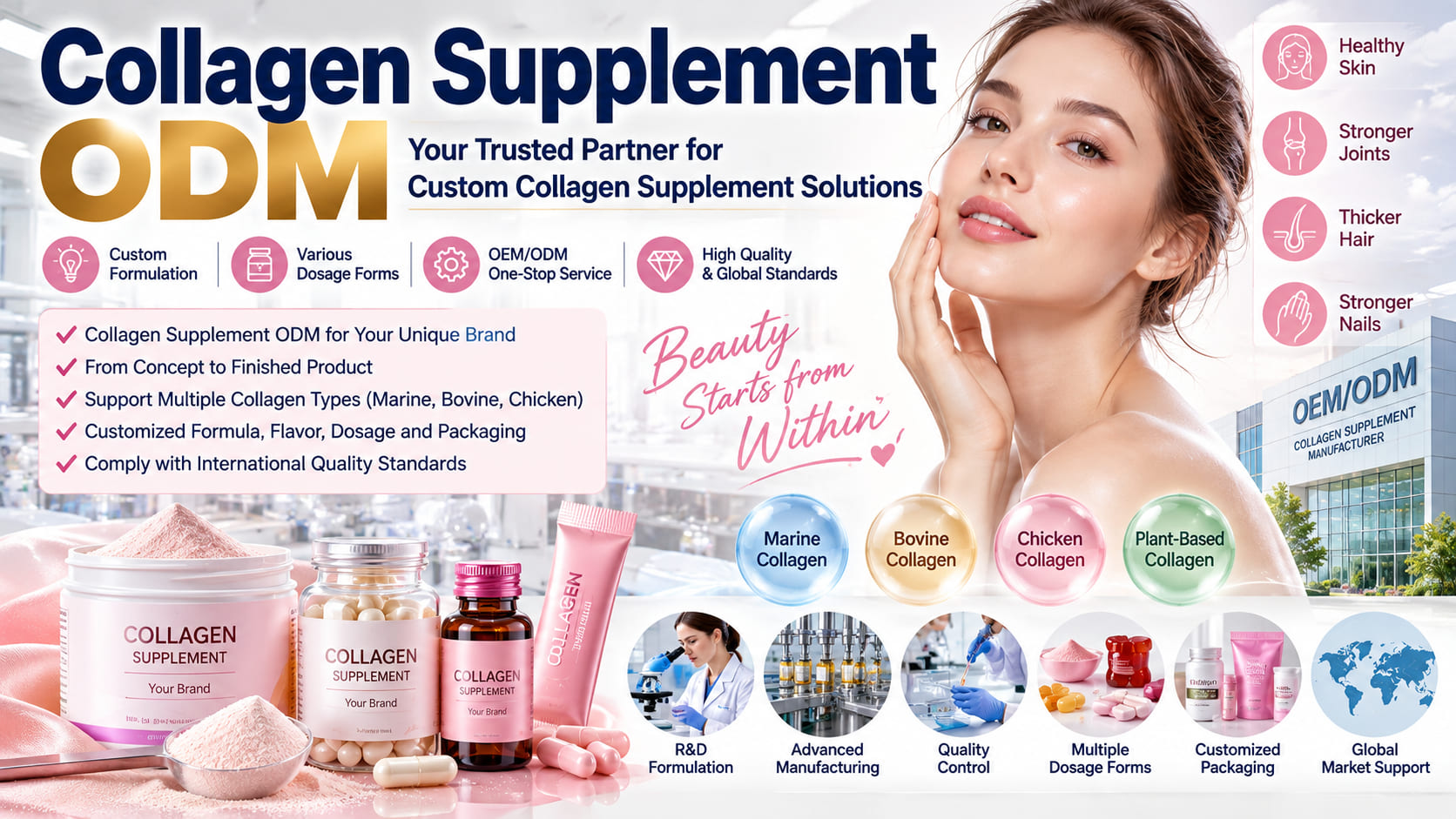
Cost Evaluation Tip: Compare quotations using equivalent specifications. Request the same collagen quantity per serving, ingredient standards, package size, testing scope, order volume, and shipping terms from every manufacturer. This provides a more meaningful comparison than unit price alone.
Collagen Ingredients, Formulations, and Product Formats
Successful collagen supplement ODM projects require more than selecting an ingredient with market appeal. Brand owners must consider consumer preferences, serving convenience, formulation stability, product positioning, and the regulatory requirements of their intended market.
Marine Collagen vs Bovine Collagen
Marine collagen is generally obtained from fish-derived raw materials, while bovine collagen originates from cattle. Both may be supplied as hydrolyzed collagen peptides. Their suitability depends on raw material specifications, consumer dietary preferences, allergen considerations, traceability, and the scientific evidence supporting the proposed product positioning.
Brands should avoid assuming that one collagen source is inherently superior for every intended benefit. Instead, evaluate available evidence for the specific ingredient, formulation, dosage, and population.
Collagen Powder Supplements
Powdered collagen supplements are suitable for products requiring gram-level servings. They can be packaged in tubs, resealable pouches, or individually portioned sachets. However, the formula must be assessed for solubility, taste, odor, moisture sensitivity, and stability.
Collagen Capsules and Tablets
Capsules and tablets offer portability and convenient portioning. Nevertheless, capsule fill capacity and tablet dimensions limit the amount of collagen that can be included per unit. Products targeting relatively high daily collagen intakes may require several capsules or tablets per serving.
Ready-to-Drink Collagen Products
Liquid collagen products may appeal to consumers seeking ready-to-use supplementation. Manufacturers must consider pH, flavor stability, packaging compatibility, microbial control, preservation strategy, and shelf-life validation. These requirements can make liquid formulation development more complex than certain dry formats.
Combining Collagen with Other Ingredients
Some collagen supplement ODM concepts combine collagen peptides with vitamin C, hyaluronic acid, or selected nutrients. These combinations should be developed around scientifically supportable positioning rather than exaggerated marketing promises. Each added ingredient must be assessed for dosage, compatibility, stability, and regulatory suitability.
Quality Control, Certifications, and Regulatory Requirements
Quality assurance is one of the most important considerations when selecting a collagen supplement ODM manufacturer. A competitive price offers limited value if the finished product cannot consistently meet its specifications or comply with its destination market's requirements.
Manufacturing Standards and Supplier Qualifications
Manufacturers should demonstrate appropriate quality management systems, documented production controls, sanitation procedures, batch traceability, and raw material verification. Depending on the product and market, buyers may investigate applicable GMP requirements, HACCP-based systems, ISO certifications, or other relevant independent assessments.
Certification claims should be verified against the actual facility, certificate scope, issuing organization, and validity period. A certificate associated with one facility or process does not automatically cover every product manufactured by the company.
Testing and Traceability
A reliable collagen supplement ODM partner should explain its procedures for ingredient identification, relevant microbiological and contaminant testing, finished-product specifications, lot tracking, and handling nonconforming materials. Additional testing may be necessary depending on ingredient origin, regulatory requirements, and risk assessment.
Labeling and Health Claims
Collagen product claims must be reviewed for each target market. For example, the United States regulates dietary supplement labeling and structure/function claims, while European Union health claims must meet applicable authorization requirements. Brands should not assume that wording accepted in one jurisdiction is permitted in another.
In the United States, certain structure/function claims require appropriate substantiation, labeling statements, and notification after marketing. Manufacturers and brand owners should allocate these compliance responsibilities clearly in their agreements.
Six Common Mistakes to Avoid When Choosing a Collagen Supplement ODM Manufacturer
- 1. Selecting a manufacturer based only on price: A low quotation may exclude testing, packaging development, documentation, or freight. Always compare complete project costs.
- 2. Ignoring formulation ownership: Without clear intellectual property provisions, a brand may face restrictions when changing suppliers or developing exclusive products.
- 3. Overlooking collagen ingredient specifications: Raw material source, traceability, allergen information, and quality criteria should be established before approving commercial production.
- 4. Failing to verify manufacturing capabilities: Not every supplement producer supports powders, capsules, tablets, and ready-to-drink formulas. Confirm equipment and process suitability.
- 5. Neglecting regulatory compliance: Unsupported claims, incorrect labels, or unsuitable ingredients may delay launch or create market access problems.
- 6. Underestimating lead times and MOQ: Custom ingredients, printed packaging, laboratory testing, and production scheduling can increase timelines and inventory commitments.
Avoiding these mistakes requires a written specification, transparent commercial agreement, agreed testing requirements, and a clearly defined project timeline. Brands should resolve critical technical and contractual questions before paying for full-scale production.
Collagen Supplement ODM Development Process: From Concept to Production
Step 1: Define the Product Concept
Identify the intended customer, target market, desired product format, brand positioning, expected retail price, and launch objectives. A clear product brief helps the manufacturer recommend realistic development options.
Step 2: Review Formulation and Ingredient Options
Discuss collagen origin, product dosage, complementary ingredients, flavor expectations, and ingredient documentation. Review potential allergens, target market restrictions, and technical feasibility before finalizing the formulation direction.
Step 3: Develop and Evaluate Samples
The manufacturer prepares development samples for evaluation. The brand reviews relevant characteristics such as flavor, appearance, dissolution, convenience, and packaging compatibility. Changes may require additional development rounds.
Step 4: Confirm Specifications and Pricing
Once the product concept is approved, both parties should confirm ingredient specifications, order quantity, packaging details, testing responsibilities, delivery terms, pricing, and intellectual property arrangements.
Step 5: Conduct Required Testing and Manufacturing
Testing and verification requirements should be finalized before commercial production. Manufacturing must follow documented controls, with appropriate batch records and release procedures.
Step 6: Packaging, Release, and Delivery
After packaging and quality review, finished goods are released according to agreed criteria. Brands should obtain relevant product documentation and confirm logistics arrangements before distribution.
How to Choose a Reliable Collagen Supplement ODM Manufacturer
Selecting the right collagen supplement ODM partner is a strategic business decision. A suitable manufacturer should understand the brand's positioning while demonstrating technical competence, production consistency, and transparent communication.
Begin by evaluating the manufacturer's relevant supplement development experience. Ask whether the company has worked with marine collagen, bovine collagen, flavored powder blends, capsules, or other formats similar to your proposed product. Relevant experience can reduce avoidable technical challenges.
Next, review documentation and quality procedures. A manufacturer should be able to explain raw material qualification, production controls, testing arrangements, batch traceability, and complaint handling. For international projects, verify whether the manufacturer understands the destination market's documentation needs.
Commercial flexibility is also important. Compare minimum order quantities, sample development fees, lead times, packaging availability, payment milestones, and reorder arrangements. If your business expects rapid growth, discuss production capacity and future scalability early.
Request a Collagen Supplement ODM Quotation
Before contacting a manufacturer, prepare a concise project brief covering your target market, collagen source, product format, approximate serving size, expected order quantity, packaging preferences, and desired launch schedule.
Recommended next step: Request a detailed quotation, formulation consultation, available documentation, and sample development information from qualified collagen supplement ODM manufacturers. Compare proposals against the same technical specifications before selecting a partner.
Collagen Supplement ODM Frequently Asked Questions
Q1: What is the difference between collagen supplement ODM and OEM?
Collagen supplement ODM generally includes manufacturer-supported product development and formulation services, while OEM typically focuses on producing products according to specifications supplied by the brand. Actual service boundaries vary between manufacturers.
Q2: How much does collagen supplement ODM manufacturing cost?
Manufacturing costs depend on collagen source, ingredient quality, formulation complexity, product format, packaging, minimum order quantity, testing, and logistics. Brands should request detailed quotations based on identical product specifications.
Q3: How long does collagen supplement ODM development take?
Development time varies by formulation complexity, ingredient sourcing, sample revisions, packaging procurement, testing, and production scheduling. Existing formulations may move faster than fully customized products, but manufacturers should confirm project-specific timelines.
Q4: Who should choose collagen supplement ODM?
Collagen supplement ODM is suitable for startups, emerging wellness brands, distributors, and established companies launching new product categories that require external formulation and development support.
Q5: What are the disadvantages of collagen supplement ODM?
Potential disadvantages include manufacturer dependency, limited customization for standard formulas, minimum order commitments, and uncertainty over formulation ownership. These concerns can be managed through supplier evaluation and clear contractual terms.
Q6: Can an ODM manufacturer create a customized collagen formula?
Many ODM manufacturers offer customized formulation services, including collagen source selection, ingredient combinations, flavor development, and packaging options. Customization capabilities and associated development fees vary by supplier.
Q7: What is the minimum order quantity for collagen supplement ODM?
Minimum order quantity depends on the manufacturer's equipment, formulation, packaging materials, and production efficiency. Powder tubs, stick packs, capsules, and liquid products may have different minimum requirements.
Q8: Is marine collagen better than bovine collagen for ODM products?
Neither source is automatically better for every product. Selection should consider ingredient specifications, consumer preferences, allergens, traceability, available scientific evidence, price, and the intended market.
Q9: What certifications should a collagen supplement ODM manufacturer have?
Manufacturers should meet applicable manufacturing and food safety requirements for the intended product and market. Buyers may review relevant GMP compliance, HACCP-based controls, ISO certifications, and supporting quality documentation, verifying each certificate's scope and validity.
Q10: How do I choose the best collagen supplement ODM manufacturer?
Evaluate formulation experience, manufacturing capabilities, quality systems, ingredient traceability, regulatory support, pricing transparency, minimum order quantity, intellectual property terms, and delivery reliability. Compare proposals using consistent product requirements.